ywkang
a143925a12
ywkang
a143925a12
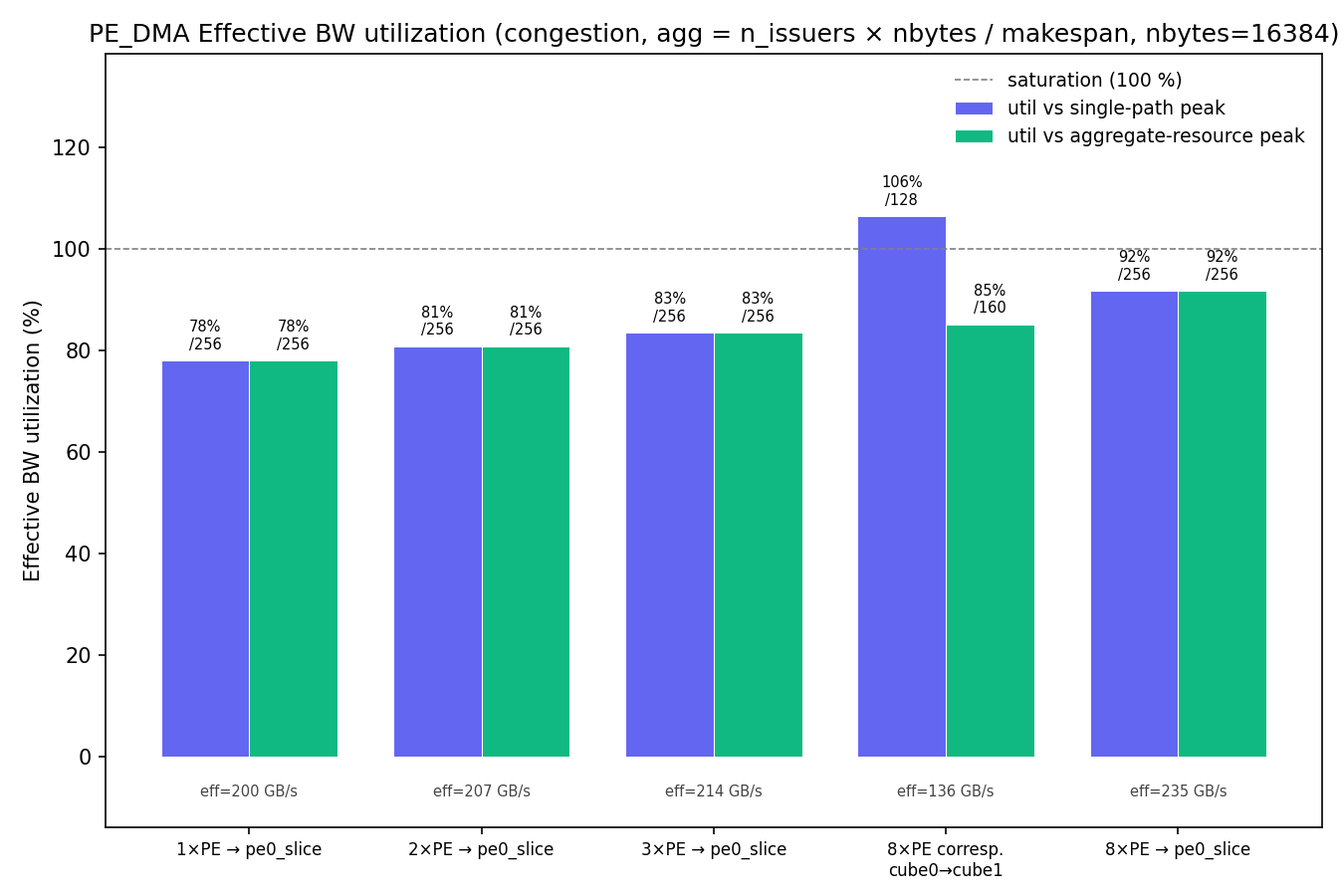
Each scenario now shows TWO bars:

  util_single    = effective_bw / single-path peak × 100
                   (peak = min bw_gbs on first issuer's path)
  util_aggregate = effective_bw / aggregate-resource peak × 100
                   (peak = max-min fair share across concurrent paths)

Aggregate peak uses a max-min fair-share computation: each concurrent
path's sustainable share on an edge is bw_gbs / usage_count, the
per-path throughput is the min share along its edges, and the aggregate
peak is the sum across paths. This produces the correct answer for both
shared-bottleneck scenarios (N paths converge on one wire → aggregate =
wire BW) and multi-lane shared resources (UCIe's 4 connections used in
parallel → aggregate ≈ 4 × per-conn BW), without enumerating max-flow.

Single-issuer (no_congestion) → util_single == util_aggregate by
definition. Congestion exposes the divergence:
  ctrl_hot_{1,2,3}, all_pe_to_pe0 → both metrics agree (one shared
                    bottleneck: r0c0→hbm_ctrl.pe0 @ 256 GB/s)
  8×PE eastbound → util_single=106 % (single conn @ 128 GB/s) but
                    util_aggregate=85 % (UCIe-W.conn0 @ 7-way shared,
                    aggregate peak ≈ 160 GB/s under the current
                    cross-cube routing that funnels via cube1.r0c0).

Verification updated to assert:
  (2) util_aggregate ≤ 100 % (effective BW can't exceed the aggregate
      resource peak, by construction).
  (3) single-issuer util_single == util_aggregate.
  (7) ucie_eastbound: util_aggregate is meaningfully smaller than
      util_single (the multi-lane peak correction is observable).

CSV grows with peak_aggregate_bw_gbs and util_aggregate_pct columns;
breakdown columns retained.

Co-Authored-By: Claude Opus 4.7 (1M context) <noreply@anthropic.com>
68 KiB
1350x900px
68 KiB
1350x900px