mukesh
d0db9ff40e
mukesh
d0db9ff40e
Make reduce_mlo derive its submesh dimensions (sub_w, sub_h, root_col,
root_row, root_cube) from C at call time, with peer-existence guards on
every inter-cube send/recv so any C ≥ 1 completes cleanly (previously
hardcoded to C=8's 4×2 mesh; non-rectangular C like 7 or 12 hit
IpcqDeadlock at the root cube's east receive). Byte-equal at C=8 —
existing composite digest tests still pass 8/8.

Callsites in the four Case-6 kernels (primitive / primitive-tiled /
composite / composite_extended) updated to pass C into reduce_mlo and
use root_cube_for(C) for the final tl.store gate.

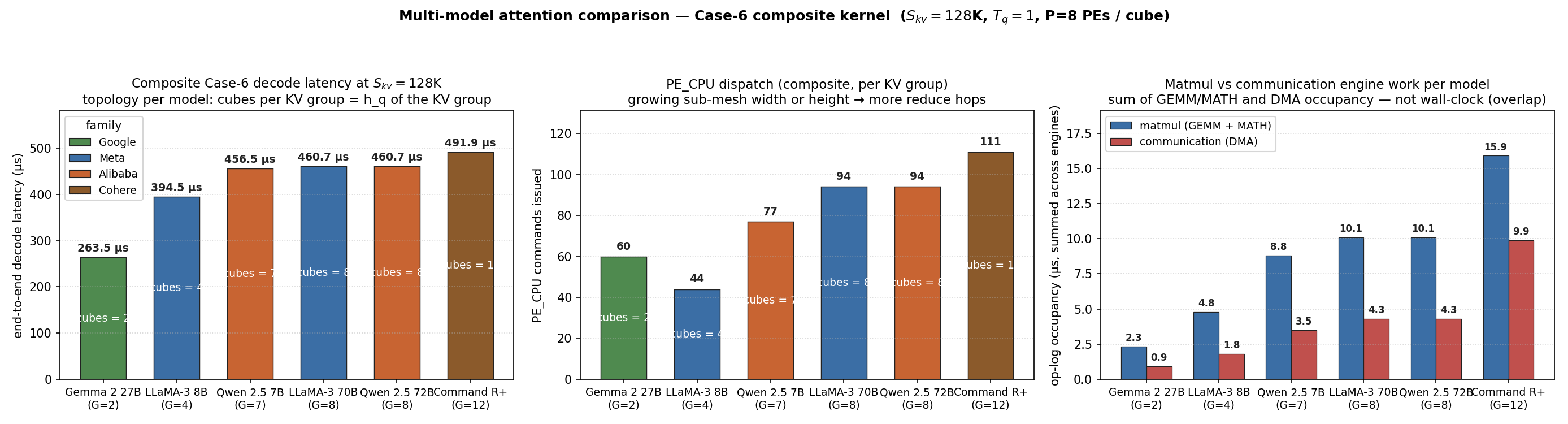
Add the multi-model attention bench: sweeps the composite kernel at
S_kv=128K across six GQA models (Gemma-2 27B, LLaMA-3 8B, Qwen 2.5 7B,
LLaMA-3 70B, Qwen 2.5 72B, Command R+), with per-model topology
C = h_q (cubes per KV group = query heads per KV group). Captures
per-op-kind occupancy (matmul GEMM+MATH, comm DMA) alongside latency
and PE_CPU dispatch. Three-panel plot writes to bench-output and
paper-figures dir.

Headline result: same-h_q-different-family models land within 0.2 µs
(model-agnostic given fixed h_kv=1 per KV group + d_head=128); latency
climbs 263 → 492 µs as C climbs 2 → 12, driven by reduce depth
(comm/matmul ratio 0.4 → 0.6 across the sweep).

Co-Authored-By: Claude Opus 4.7 (1M context) <noreply@anthropic.com>
169 KiB
2775x750px
169 KiB
2775x750px