ywkang
a76487ca48
ywkang
a76487ca48
User asked to surface system-wide congestion (more accurate than
single-cube), bring back the latency-breakdown plot under a separate
filename, and rename the obscure ``streaming`` category.

Scenarios:
  Renamed all_pe_to_pe0 → all_pe_cube0_to_pe0 (clarify cube scope).
  Added two SIP-wide scenarios:
    sip_local_all     — every PE in sip0 (128 total) accesses its own
                        local slice. All paths disjoint (each PE owns
                        its own hbm_ctrl.peX), so the model should
                        scale linearly with cube count.
    sip_hotspot_pe0   — every PE in sip0 (128 total) targets
                        sip0.cube0.pe0_slice. Worst-case hotspot:
                        UCIe inbound + r0c0→hbm_ctrl.pe0 saturated.
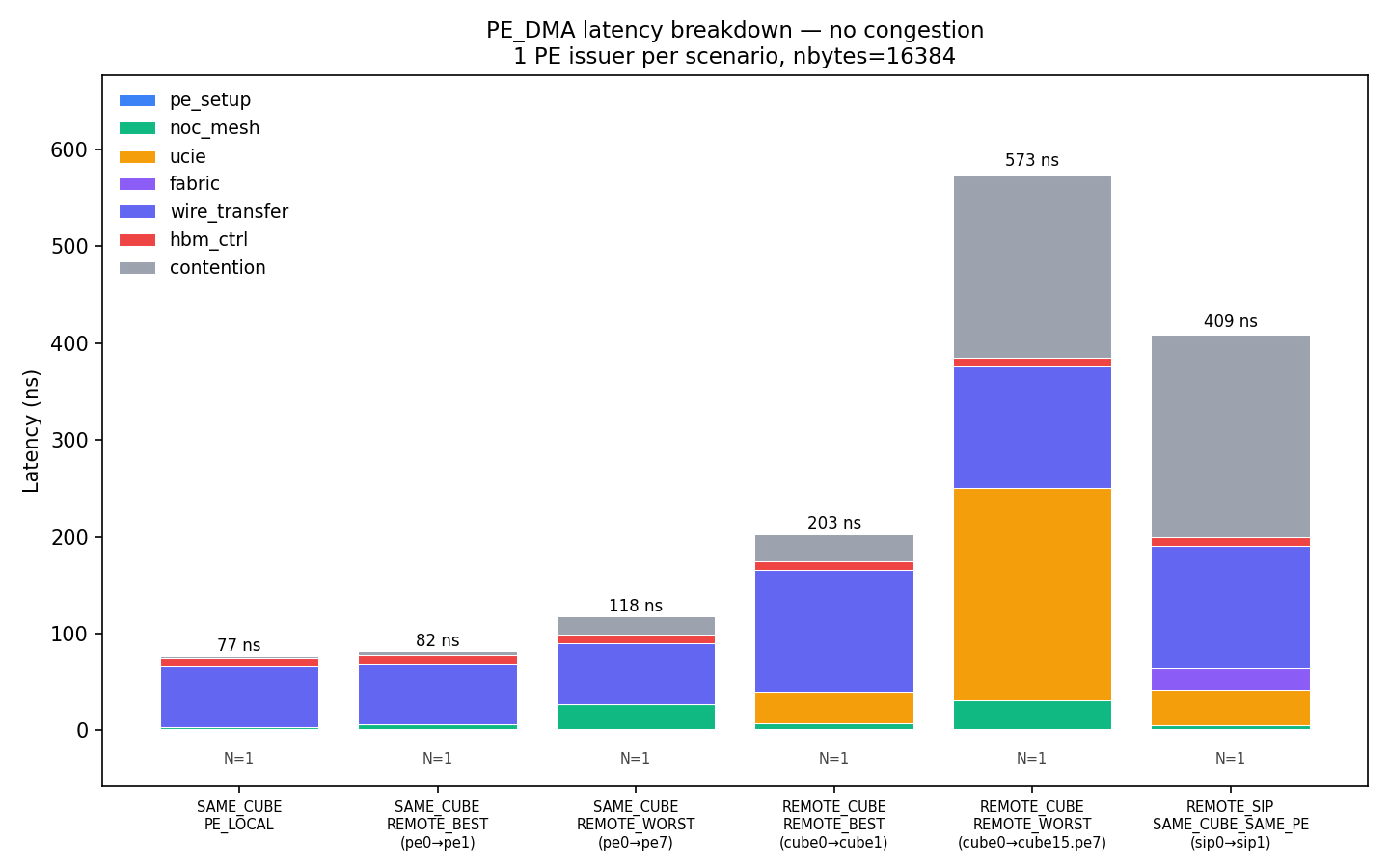
  Each bar now carries an ``N=...`` annotation showing the issuer
  count, and the chart titles say the scope explicitly.

Effective BW + util at 16 KB:
  sip_local_all       N=128  eff= 27.2 TB/s  util_a= 83 %
  sip_hotspot_pe0     N=128  eff= 134 GB/s   util_a= 93 %
                                              (UCIe-into-cube0 saturated)

Plots:
  no_congestion.png + congestion.png        — Effective BW utilization
                                              (two bars: single vs aggregate peak)
  breakdown_no_congestion.png +
  breakdown_congestion.png                  — stacked latency breakdown
                                              (renamed from previous)
  summary.csv with columns for both views.

The visual y-cap on BW utilization is 150 %. Bars exceeding it (e.g.
sip_local_all's util_single = 10,639 %) are drawn at the cap with an
upward arrow and the real value annotated. The verification rule for
``util_single`` is loosened to ``≤ n_issuers × 100 % + 5 %`` so
massively-parallel disjoint scenarios pass.

Category renamed: ``streaming`` → ``wire_transfer``. It is the
bulk-transfer time = (n_flits − 1) × flit_bytes / bottleneck_bw — the
cost of streaming the rest of the payload through the slowest wire
after the first flit has arrived.

All checks PASS.

Co-Authored-By: Claude Opus 4.7 (1M context) <noreply@anthropic.com>
64 KiB
1440x900px
64 KiB
1440x900px